




Few places in the Adriatic spark curiosity as much as the Blue Cave on Biševo Island. It’s a place we’ve been visiting summer after summer, so after years of navigating the waters, we’ve come to know it beyond the postcard version. After seeing different light conditions and weather changes, we can say that each visit is at least slightly different than the last one. The famous Blue Cave (Modra špilja) is one of the most photographed natural attractions in Croatia. The reason for that is its glowing blue hue – created by sunlight peeking through the underwater opening of the cave, it creates a surreal, otherworldly atmosphere.
The ambience of the cave is something that photographers and travelers try to capture every summer. And even though no photo will ever do it justice, we’ve managed to put together a simple guide with tips and tricks on how to get the perfect Blue Cave photo.
When is the best time to visit the Blue Cave?
Before we get into the do’s and don’t’s of photography, let’s start with the fundamental part – timing, light and the conditions.
As famous as it is, visiting the Blue Cave is about arriving at the right moment and in the right conditions. Timing and logistics truly make the difference. With that being said, it’s good to know that the best time to arrive is the summer, in the period between 10:30 AM and 1:30 PM. That’s when the sun is high enough for the light to pass through a crack on the cave’s arched roof, so the whole interior gets illuminated with the beautiful, electric blue glow.
If your expectations are high because of the pictures you’ve seen online, best believe that the live scenery will do them justice!
Another important logistical detail? You guessed it – the weather conditions. Calm seas, clear skies and minimal wind allow the sunlight to enter the cave in a way that makes the water appear brighter and more luminous. If the sea is rough, the sailing may not be as pleasant as you’d expect. In addition, if the sea level is too high, it’s impossible to pass through the narrow entrance of the cave.
Moreover, when you enter the cave, you have to transfer to a small wooden boat operated by a licensed local guide. These boats are specially designed to navigate the cave without doing any damage to it. Entering the cave usually lasts a minute or two, so have your camera ready – you don’t want to miss the amazing moment of the blue color lighting up the area.
Best photo angles
Now, when you’re inside the cave, you want to enjoy being in the moment, but also have a long-lasting memory of the magnificent scenery you get to witness. That’s why we got some recommendations for types of angles and photo settings to get the best out of your little gadget.
The internal wide-angle
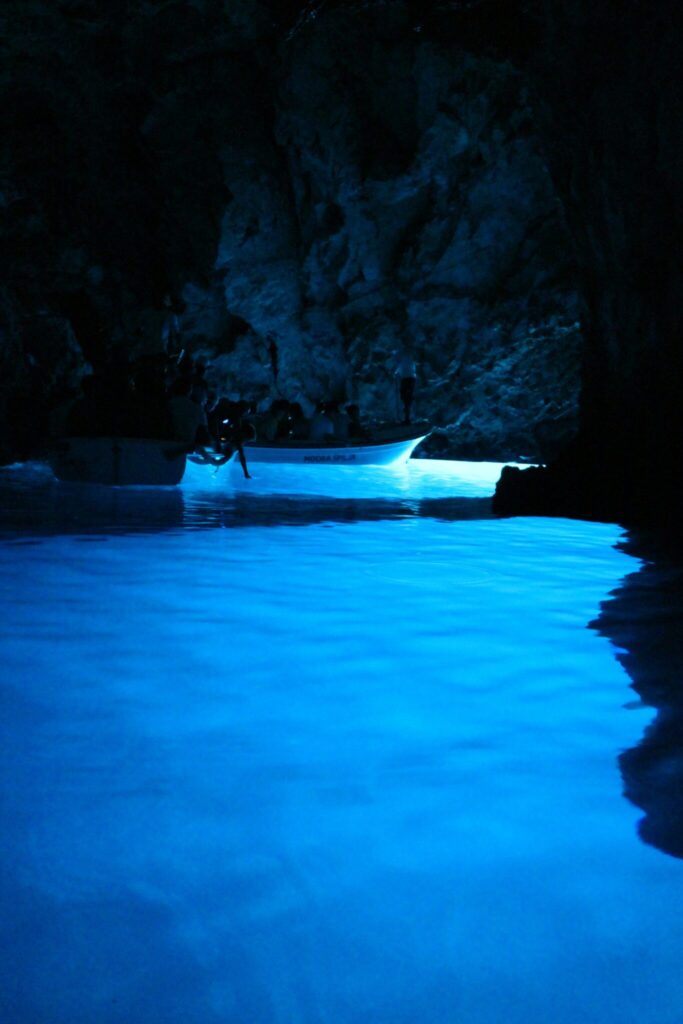
Set the angle in a way that keeps your camera on a low level and shoots from your small boat across the cave. Aim for the contrast between the dark, rocky walls and the intensely glowing, bright water. This composition works really well with the wide-angle lens or the ultra-wide setting on your phone. The dramatic contrast between the two is what gives the photos a distinctive look.
If possible, frame another boat in your vicinity. This adds scale and helps viewers understand the size of the cave, which is often difficult to convey in photos.
The famous “entrance duck”
If you want to film a vertical video for social media, start recording a few moments before your wooden boat passes through the entrance of the cave. Point your phone slightly upward as your boat passes through the narrow opening and bring it down again as you are finally inside.
The luminous glow of the cave will amaze you every time you replay the video.
This is one of those moments that would work perfectly for Instagram Reels or TikTok, especially if you’re filming a guide or a personal travel vlog. The transition from darkness to bright blue light creates an effect that won’t require extra editing.
Also, try keeping your phone steady and avoiding zooming in too much. The natural change in light is already a powerful visual moment on its own.
Underwater shots
The most fascinating thing about this phenomenon is that when you put your hand under the surface, it glows. And if you’re carrying a camera that you can freely dip in the water, it’s no wonder you want to make that moment last a lifetime. However, it’s important you follow your guide’s instructions and avoid doing anything that could harm the ecosystem, which the electronics could possibly do.
Once you’re safely taking photos, try to capture the silver glimmer on the surface and then reposition the angle to reveal the blue depth underneath. Because of the white seabed, the objects below the water surface seem to appear fluorescent.
Your camera probably won’t be able to capture something exactly the way your eyes see it, but with the right exposure you can get surprisingly close.
Camera settings and equipment for Blue Cave photography
Because of the high contrast in the cave’s interior, your camera may struggle with exposure.
A few simple adjustments may help:
- Try using HDR mode on your phone to balance shadows and highlights. It will prevent shadows from being too dark or bright spots from being too white.
- Slightly lower the exposure so you get a quick balance of the glowing water.
- Start with ISO 200-400 to preserve image quality and avoid noise. Because the cave interior is quite dark, you may need to increase it to ISO 800 or higher, especially in lower light conditions. Finding the right balance is key – too low ISO will make your image too dark, while too high ISO may introduce unwanted grain.
- If you are filming a video starting from the outside, lock exposure so the camera doesn’t constantly readjust. This will help maintain a smooth transition without sudden changes in brightness.
- A wide-angle lens is the way to go if you want to capture the depth and the scale of the cave.
- A phone with night mode can be quite effective for this environment, maybe as equally good as a digital camera.
- Having a waterproof bag or case on hand is a good addition to these kinds of tours, as they protect your phone from the water splashing on the screen.
Additional tips
It’s good to know that using flash is not permitted. The goal is to preserve this natural phenomenon and not do any harm to the natural ecosystem of the cave. Don’t worry, not using the flash won’t be a problem, as you still get to capture amazing visuals while respecting the local authorities.
Stability is the key – since the boats are small, the tripods would be impractical on a boat. Use your body to keep the camera steady. Try resting your elbows on your knees or leaning against one side of the boat for extra support and smoother shots.
Also, keep it simple: be prepared to act quickly, as you will only have a limited amount of time inside the cave. Have your camera ready in advance and avoid overthinking your settings, so you don’t miss the moment when the cave lights up in its full intensity.
And finally, don’t forget to enjoy the moment. Having good pictures is great, but nothing beats seeing the interior of the cave for the first time with your own eyes.
Safety in the Cave
After all the tips and tricks on getting a good frame, we feel obligated to share some safety tips. It may seem that these are common sense, but… you’d be surprised.
Don’t stand up in the boat. We know this may seem like a great idea to capture a better angle, but trust us, it’s not. Your safety is our top priority. Since the boats are small and the space in the cave is limited, any sudden movement can easily disturb the balance of the cave. And you might hit your head as well.
After all the tips and tricks on getting a good frame, we feel obligated to share some safety tips. It may seem that these are common sense, but… you’d be surprised.
Don’t stand up in the boat. We know this may seem like a great idea to capture a better angle, but trust us, it’s not. Your safety is our top priority. Since the boats are small and the space in the cave is limited, any sudden movement can easily disturb the balance of the cave. And you might hit your head as well.
Experience the Blue Cave with Condor Yachting
If you want to experience this natural beauty with a local touch, join our team at Condor Yachting and have a day to remember. Our Blue Cave & 5 islands group tour is available every day from mid-April to the end of October, perfect for enjoying the adventure along with other travelers on a planned itinerary.
If you’re looking for more comfort and a premium experience, our private tour to the Blue Cave and 5 islands allows you to explore at your own pace, with extra flexibility and personalized service.
Contact us today and make the most of your visit to the Blue Cave and the beautiful five islands.